
We resurrected and updated an old fave chart “Muni Feast Famine.”
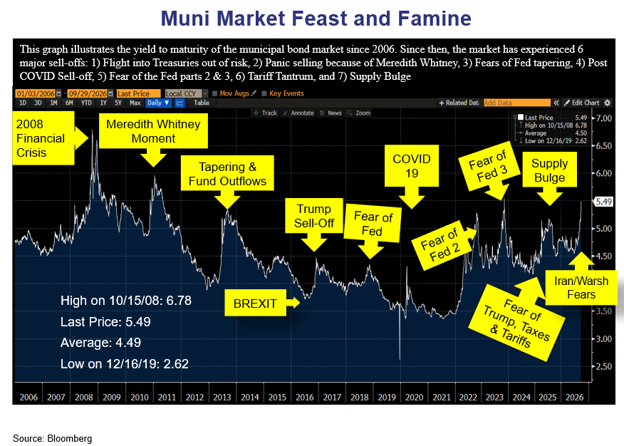
It is a chart of the Bond Buyer 40 yield to maturity. It goes back 20 years and marks periods of time when tax free Munis sold off significantly. Some of them are well-known events like the Great Financial Crisis and Covid. Some of the sell-offs are led by declining Treasury prices and higher yields, others are Muni only. Others are significant but less remembered, like the Meredith Whitney debacle, when a noted bank analyst went on “60 Minutes” and predicted hundreds of millions of dollars of municipal pensions defaulting in 2011 and 2012 (note: it didn’t happen, but the fear factor sold off the market nonetheless, and it was a Muni only event- not Treasuries). Another one that has faded in some investors’ minds was the sell-off in 2013 when then Fed Chairman Ben Bernanke said he may start to taper the amount of Federal Reserve bond buying “sooner than later”. This was another sell-off – this one led by Treasuries, which took Munis along with it.
The various sell-offs have a few things in common – usually a flux of selling in the Muni markets from bond funds, individuals, or both. And if you look at the rise in Muni yields in these different sell-offs, yields rise quickly and at an increasing rate; the slope of the yield rise is greater than 1. This kind of yield move is unusual and is in every case followed by a recovery in the Muni market.
Below is a chart showing the change in Muni yields from September 1st to last Friday and showing the yield ratio of the Muni to Treasury market as well. You can see how dramatic the recent sell-off has been. You are now at a point where longer bond Muni yields are at 5% and, in many cases, much higher. The cheapness of the Muni market can be seen in the significant rise across the yield curve in taxable equivalent yields. In this environment, municipal bond underwriters become very risk-averse. In the goal of not having unsold balances of new issues, they tend to price deals much cheaper than the secondary market, which causes the secondary market to cheapen up, which causes new issues to get even cheaper, which can cause bond fund outflows and the market suffers from a negative feedback loop.
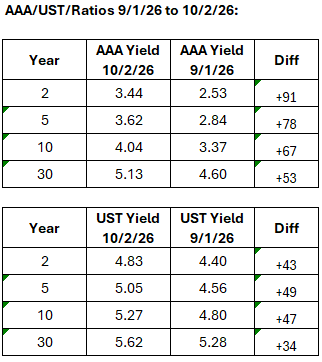
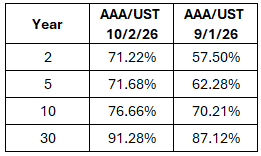
What causes the market to start to recover? In the case of the Muni market, there are a few scenarios. One, there is natural mean reversion which is simply when something moves unusually far above or below its normal level, it tends to move back toward that level over time. We are likely starting to see the beginnings of that now. Two, we begin to see crossover buyers enter the market. These are traditional taxable buyers such as life insurance companies, foundations, or pension funds that recognize the oversold condition of the Muni market and enter it seeing the chance to capitalize on an incremental return when the Muni market rights itself. Three, general market retail accounts begin to pick their heads up at the significantly higher taxable equivalent yields. Though the AAA scale was 5.13% at the start of the month, many issues are priced at 5.25% or cheaper. A yield of 5.25% in a no-state-income-tax state is 8.8% (using the federal surtax) and over 10% in high-tax states like California and New York. Those kinds of returns look competitive on a risk-adjusted basis versus long-term equity returns. And when you factor in 3.4% 12-month trailing CPI but 2.4% trailing core CPI, Munis start to look attractive.
John R. Mousseau, CFA
Chief Investment Officer
Feedback | Bio
Sign up for our Market Commentaries
Cumberland Advisors Market Commentaries offer insights and analysis on upcoming, important economic issues that potentially impact global financial markets. Our team shares their thinking on global economic developments, market news and other factors that often influence investment opportunities and strategies.
Links to other websites or electronic media controlled or offered by Third-Parties (non-affiliates of Cumberland Advisors) are provided only as a reference and courtesy to our users. Cumberland Advisors has no control over such websites, does not recommend or endorse any opinions, ideas, products, information, or content of such sites, and makes no warranties as to the accuracy, completeness, reliability or suitability of their content. Cumberland Advisors hereby disclaims liability for any information, materials, products or services posted or offered at any of the Third-Party websites. The Third-Party may have a privacy and/or security policy different from that of Cumberland Advisors. Therefore, please refer to the specific privacy and security policies of the Third-Party when accessing their websites.