
The tax-free municipal bond market has made a remarkable comeback since late July.
The muni market – particularly the longer maturity end has been pressured from a number of angles this year.
In March of this year, Congress began to mull over (as new Congresses have done in the past) the possibility of taxing municipal bonds. The discussion centered around taxing new municipal bonds, not grandfathering existing issues. Also discussed was taxing all municipal bonds, existing and new bonds going forward. The third option was a 28% cap on the benefit of municipal interest. This option had been discussed in other administrations and went nowhere, just like this year, as it was complex to explain.
The second buffet of forces on the muni market was in April when the Trump administration launched “Liberation Day” and the uncertainty of tariffs and their potential to zap up inflation and /or slow the economy took hold. That was quickly followed by the onset of the President Trump musings about firing Jay Powell. This caused tremendous consternation in the Treasury market, and the subsequent volatility of Treasury yields made hedging any municipal bonds – new issue or secondary – almost impossible for dealers. Hence, the bid side dropped out of the muni market.
The volatility of that week in April can be seen in the graph below. The graph does not show intra-day highs and lows in yields, just closing. But in one early week in April, the market lurched from 4.10 to 3.90 to 4.70. All in four days. That is the type of volatility that paralyzes the muni market.
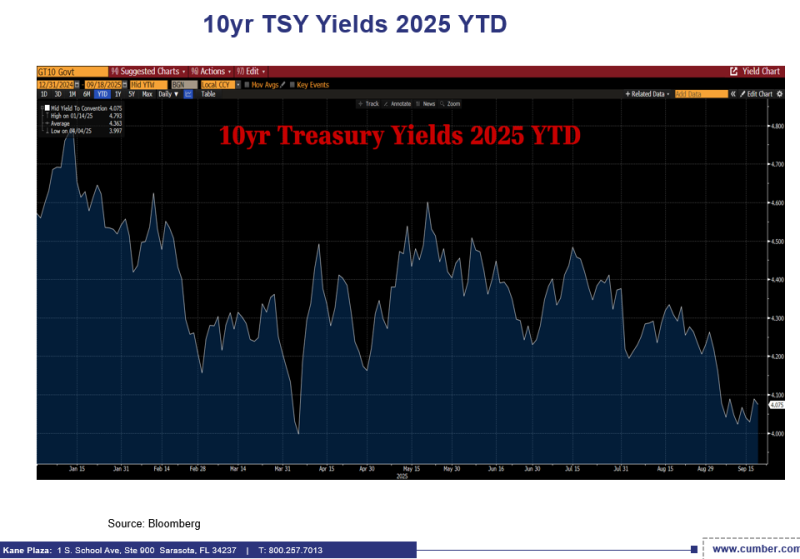
Like most market-moving events, subsequent repeats produce less movement, and tariff talk and Jay Powell firing talk barely move the needle now – but it was a different story 6 months ago.
The final punch to the muni market came in July this year with a large imbalance of steady supply at the end of the month into a market which had spent most of the large July redemptions, which included coupon payments, matured bonds, and called bonds. This imbalance caused muni yields, particularly longer yields, to rise,
During this time both muni yields and Treasury yields in the long end were most vulnerable. Fear of tariffs drove inflation expectations higher, and that particularly hurt longer-duration instruments.
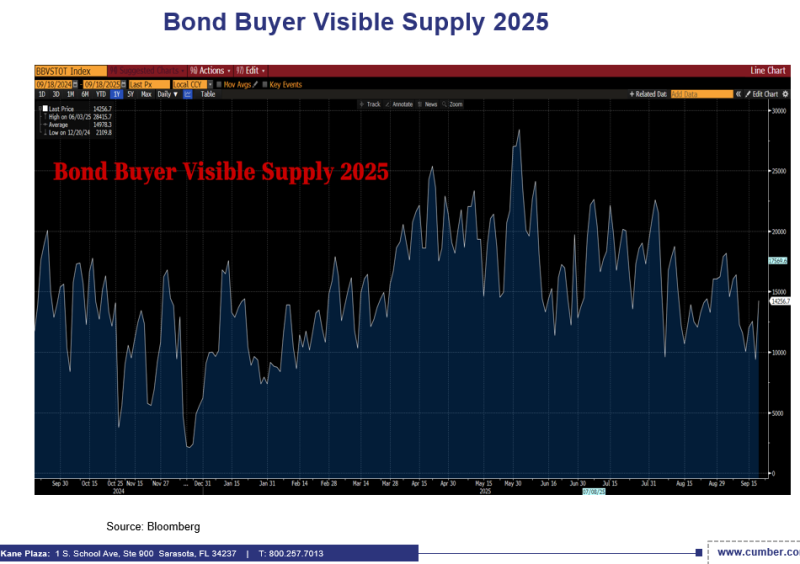
Late July of this year saw a severe mismatch between supply and demand in the muni market. Issuers who had postponed issuance back during the April volatility came to market in mid-summer. However, they all came towards the end of July in a supreme bout of mistiming. Most rollover money- maturing bonds, coupon payments, and called bonds hit the market on July 1. By the time the large issues came to market later in the month, most of that money had already been spent. So longer bonds in particular got priced into a vacuum. Below is the visible supply so far this year (supply of bonds to be offered in the 30 days forward). The July numbers are important because they show the steadiness of heavy supply.
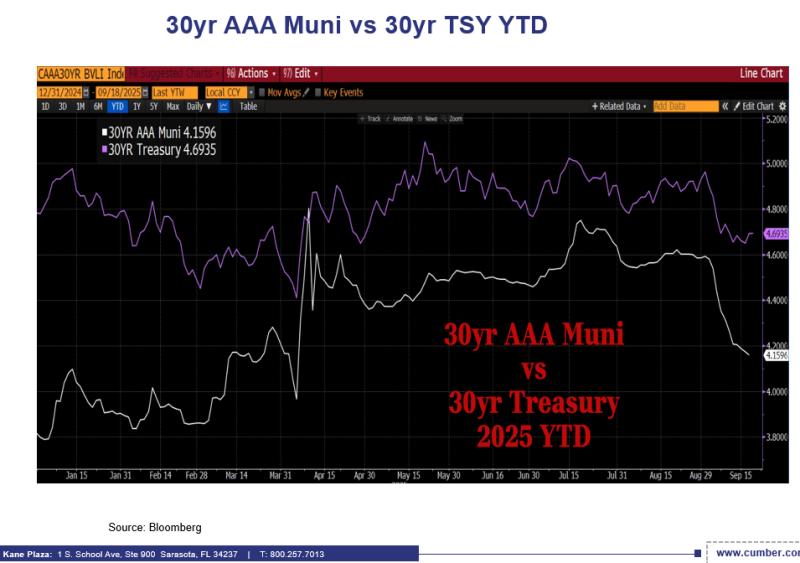
The last graph shows the yields of the thirty-year AAA muni yield and the thirty-year Treasury yield. As you can see, the markets have returned to more normal relative levels, especially over the past month. What happened?
- On the muni side, supply leveled off. We are running approximately 17% ahead of last year, but we expect supply to be more muted over the balance of the year.
- Demand has picked up with steady flows into bond funds – $29.3 billion over the past 10 weeks. In addition, when deals were coming with longer munis over 5% and significantly cheaper than Treasuries, we saw “crossover” buyers come into the market – nontraditional muni buyers taking advantage of the distortion in yields. Hence most deals over the last month have been very oversubscribed, and both primary and secondary markets are enjoying much better liquidity.
- There has been an easing of concerns over tariffs and their inflation expectations. Tariffs are being recognized as mostly a one-time change in prices that may indeed have a negative effect on consumer spending. Inflation expectations have also been brought down by a number of softer economic figures. We have seen a bubbling up of labor market concerns, with monthly jobs numbers being less than expected and significant downward revisions to earlier months.
- There was a pickup in jobless claims (though not this week) and more announced layoffs from companies (Conoco Phillips announcing a 20-25% reduction in its workforce last week). And while overall there is not much firing, there is clearly not much hiring.
- There are drops in housing prices as well as rents. Not everywhere in the country, but overall. This will help push down inflation going forward.
- The Fed, in cutting twenty-five basis points Wednesday, cited deterioration in labor markets as one of the reasons for their cut. And while there can be valid discussions about whether the economy needs more rate cuts, the markets are forecasting another couple of cuts between now and year end.
The final quarter of most calendar years tend to be good for tax-free bonds. There are the large December and January reinvestment periods in front of us. And if the economy is indeed slowing, there should be some shifting into fixed income assets in general. We expect this to be the case in 2025, especially after the bouts of illiquidity earlier in the year.
John R. Mousseau, CFA
Vice Chairman | Chief Investment Officer
Bio
Sign up for our Market Commentaries
Cumberland Advisors Market Commentaries offer insights and analysis on upcoming, important economic issues that potentially impact global financial markets. Our team shares their thinking on global economic developments, market news and other factors that often influence investment opportunities and strategies.
Links to other websites or electronic media controlled or offered by Third-Parties (non-affiliates of Cumberland Advisors) are provided only as a reference and courtesy to our users. Cumberland Advisors has no control over such websites, does not recommend or endorse any opinions, ideas, products, information, or content of such sites, and makes no warranties as to the accuracy, completeness, reliability or suitability of their content. Cumberland Advisors hereby disclaims liability for any information, materials, products or services posted or offered at any of the Third-Party websites. The Third-Party may have a privacy and/or security policy different from that of Cumberland Advisors. Therefore, please refer to the specific privacy and security policies of the Third-Party when accessing their websites.