We saw a convulsive reaction to Federal Reserve Chairman Kevin Warsh’s press conference on Wednesday July 29th, following the Fed’s decision to keep the fed funds target rate at 3.50–3.75% for the fifth meeting in a row. The vote was 9-3 to keep rates where they were, with the presidents of the Cleveland, Minnesota, and Dallas Feds voting to raise the rate a quarter point.
Following the Chairman’s remarks, both equity and bond markets voted with their feet. The 10-year Treasury yield moved from 4.62 to 4.67; the 30-year bond moved from 5.12 to 5.20; and the Dow ended off over 1100 points for the day.
What happened? Well, markets were attuned to the new Fed Chairman, who has avowed that he will make fighting inflation job one. There was not much discussion there. One of the basic tenets of public speaking is to follow these three straightforward rules:
- Tell them what you are going to tell them.
- Tell them.
- Tell them what you told them.
He never really got to any of them. With three dissents, there was clearly some discussion about possibly raising rates because of the increase in energy prices and the uncertainty of the path of the war and a possible resolution of it (read: oil prices higher for longer).
There was no real discussion of what factors would lead to a softer economy and be a reason to keep rates where they are. By the time Chairman Warsh finished, the markets had fully decided to drop back and punt. Markets were already on the weak side. They became weaker fast.
7/29/2026 | 10-YR | 30-YR | DOW |
2:00 PM | 4.6224 | 5.125 | 52112.04 |
Close | 4.6712 | 5.1997 | 51868.34 |
With all the volatility, longer bonds have certainly become more attractive on a real-yield basis. Below is a graph showing the 30-year US Treasury yield, trailing CORE CPI, and the difference (real yields), going back 10 years.
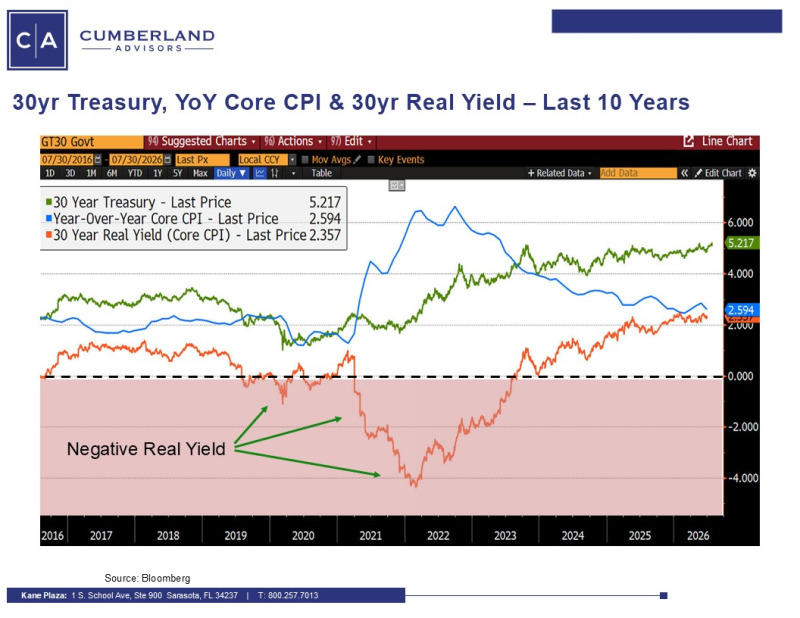
We can see the negative real yields that were present during Covid, but we now see long-maturity real yields at the highest level in the past 10 years. And it is important to remember that high-grade corporate bonds and taxable municipal bonds are at 75–85 basis points higher than Treasuries, which would be a real yield WELL above 3.25% and closing on 3.5%.
Longer high-grade tax-free bonds at 4.75% represent a taxable equivalent of over 7.5% at the top federal rate, that is, a real rate of almost 5%. It is clear that the longer end of the bond market is doing some of the Fed’s work for them.
Is there further pain to go in the bond markets? Maybe. Eventually higher rates start to bite on the economy. And higher short-term rates, if the Fed eventually hikes, will also help to curb inflation.
We hope that Chairman Warsh does a better job of explaining the Fed’s outlook next meeting. We have no doubt that he will.
John R. Mousseau, CFA
Chief Investment Officer
Feedback | Bio
Sign up for our Market Commentaries
Cumberland Advisors Market Commentaries offer insights and analysis on upcoming, important economic issues that potentially impact global financial markets. Our team shares their thinking on global economic developments, market news and other factors that often influence investment opportunities and strategies.
Links to other websites or electronic media controlled or offered by Third-Parties (non-affiliates of Cumberland Advisors) are provided only as a reference and courtesy to our users. Cumberland Advisors has no control over such websites, does not recommend or endorse any opinions, ideas, products, information, or content of such sites, and makes no warranties as to the accuracy, completeness, reliability or suitability of their content. Cumberland Advisors hereby disclaims liability for any information, materials, products or services posted or offered at any of the Third-Party websites. The Third-Party may have a privacy and/or security policy different from that of Cumberland Advisors. Therefore, please refer to the specific privacy and security policies of the Third-Party when accessing their websites.